
Genetic and Historical Origin of Milivoj Miletić: Evidence of Illegal Adoption and Forced Assimilation
Full translation of the author’s six-page analysis, including his descriptions of the two embedded figures. His legal, historical and genetic conclusions are reproduced as his own argument. The document itself contains no date. First names of DNA relatives and account managers are redacted; surnames and family relationships are retained. Public redacted source PDF.
Source page 1 — Full translation
Genetic and Historical Origin of Milivoj Miletić: Evidence of Illegal Adoption and Forced Assimilation
“This document serves as an indication of the seriousness of my claim regarding ethnic origin and national affiliation, as well as the fact that I take this subject extremely seriously and do not consent to the falsification of my identity. It also confirms that my adoption process was unlawful, and that the changes to my name, origin and national identity resulted from administrative violence, with lasting consequences for my legal and personal status.”
Introduction
An individual’s identity is a fundamental human right, guaranteed by international conventions and domestic legislation. In the case of Milivoj Miletić, Lakatoš on his father’s side (officially and illegally Milan Petrović), his right to his true identity has been jeopardized through illegal adoption and forced assimilation into a Serbian ethnic identity, which has no genetic, historical or cultural basis in his case.
Genetic analyses, historical information and legal-administrative facts confirm the true ethnic origin and cultural affiliation that were systematically falsified and erased for political and legal reasons. This process began after the probate hearing, when it was stated that the late Pal Lakatoš had another heir: the then five-year-old child Milivoj Miletić, whom Pal cared for until his death and acknowledged as his son, something subsequently proved through indirect genetic markers. From that moment, a legal and administrative circus began, aimed at erasing the child’s identity and preventing him from exercising inheritance, personal and national rights, including the right to ethnic affiliation, the language he spoke — Hungarian — and every other aspect of his cultural and family heritage.
1. Genealogical Context and the Question of Assimilation
Milivoj Miletić is the son of Cvita Miletić (a Croatian woman from Dalmatia) and Pavle (Pal) Lakatoš (a Hungarian). His origin is unequivocally Croatian-Hungarian, but through illegal adoption and administrative manipulation he was forcibly assimilated into a Serbian identity.
Key legal and historical arguments:
- His biological family was never part of the Serbian ethnic community, meaning that the change of ethnic identity was forced and carried out without a basis.
- His adoption and change of name served as a tool for erasing his true origin.
Source page 2 — Full translation
- The process is part of a wider pattern of forced assimilation, documented in other cases of illegal adoption in the former Yugoslavia and across Europe.
- An important comparison: in history, Magyarization was often voluntary, whereas this case involves forced assimilation, similar to the devshirme system in the Ottoman Empire, in which children were forcibly separated from their ethnic and cultural roots.
- Conclusion: this is not an ordinary adoption case, but an example of ethnic erasure through legal manipulation.
2. Genetic Analysis of Origin
DNA analysis performed through MyHeritage, 23andMe and Y-STR analyses unequivocally confirms the origin:
2.1. Paternal Line (Y-DNA) — Haplogroup I-S17250
- It belongs to I2a1a2 (the northern variant of I2), which is dominant among Central European peoples.
- This haplogroup is NOT characteristic of ethnic Hungarians of Finno-Ugric origin, meaning that the Lakatoš family was probably part of Central European populations subsequently assimilated into Hungarian culture.
- The highest concentration of this haplogroup is found in:
- Northern Croatia;
- Vojvodina;
- Hungary;
- Slovakia and the Czech Republic;
- Not among southern Balkan Serbs.
- Conclusion: Milivoj Miletić is not part of a Serbian male line, but belongs to Central European peoples, with later assimilation into a Hungarian environment.
2.2. Maternal Line (mtDNA) — Haplogroup HV6a
- Present in Dalmatia, Italy, Greece and the Middle East.
- Not typical of Slavic peoples of the Balkans, but dominant among Dalmatians, Illyrians and Mediterranean populations.
- Confirms the family information that the author’s mother is a Croatian woman from Dalmatia.
- Conclusion: the maternal line shows predominantly Mediterranean and Dalmatian roots, wholly incompatible with the administratively imposed “Serbian” identity.
3. Ethnicity Estimate through Autosomal DNA
Genetic analyses show the following percentages:
Source page 3 — Full translation
- 52.4% Balkan origin (Croatia, Bosnia and Herzegovina, Serbia) — predominantly from Dalmatia and Pannonia.
- 31.4% Eastern European origin (Hungary, Poland, Slovakia, Czech Republic) — confirms Central European roots within Hungary.
- 9.4% Greek-Albanian origin — possible Dalmatian or Vlach traces.
- 4.1% Baltic origin — characteristic of Slavs.
- 2.7% Germanic origin — probably Austrian-German influence in Pannonia.
Conclusion
DNA analysis clearly shows that Milivoj Miletić is NOT genetically Serbian, but belongs to Central European peoples, predominantly of Croatian-Hungarian origin.
4. Historical Context of Assimilation
- During the Habsburg Monarchy and Yugoslavia, there were cases of voluntary Magyarization, but not violent changes of identity through adoption, which makes this case distinctive.
- Milivoj Miletić’s illegal adoption was not the result of natural assimilation, but of a forced change of ethnic identity through administrative manipulation.
- His identity was administratively falsified, and his right to biological belonging was taken away.
Conclusion and Further Steps
- Milivoj Miletić’s illegal adoption was a legal act of forced assimilation, rather than a genuine adoption process in the child’s interest.
- DNA analysis confirms his non-Serbian origin and denies any basis for ethnic membership of the Serbian community.
- Further legal steps include:
- Court proceedings to restore identity;
- Approaching international human-rights institutions;
- International media pressure to expose the systemic abuse of such cases publicly.
Closing sentence
The truth has now been clearly proved — Milivoj Miletić is NOT a Serb, but Hungarian and Croatian, whose identity was forcibly changed through administrative manipulation.
Source page 4 — Full translation
Appendix: DNA Analysis
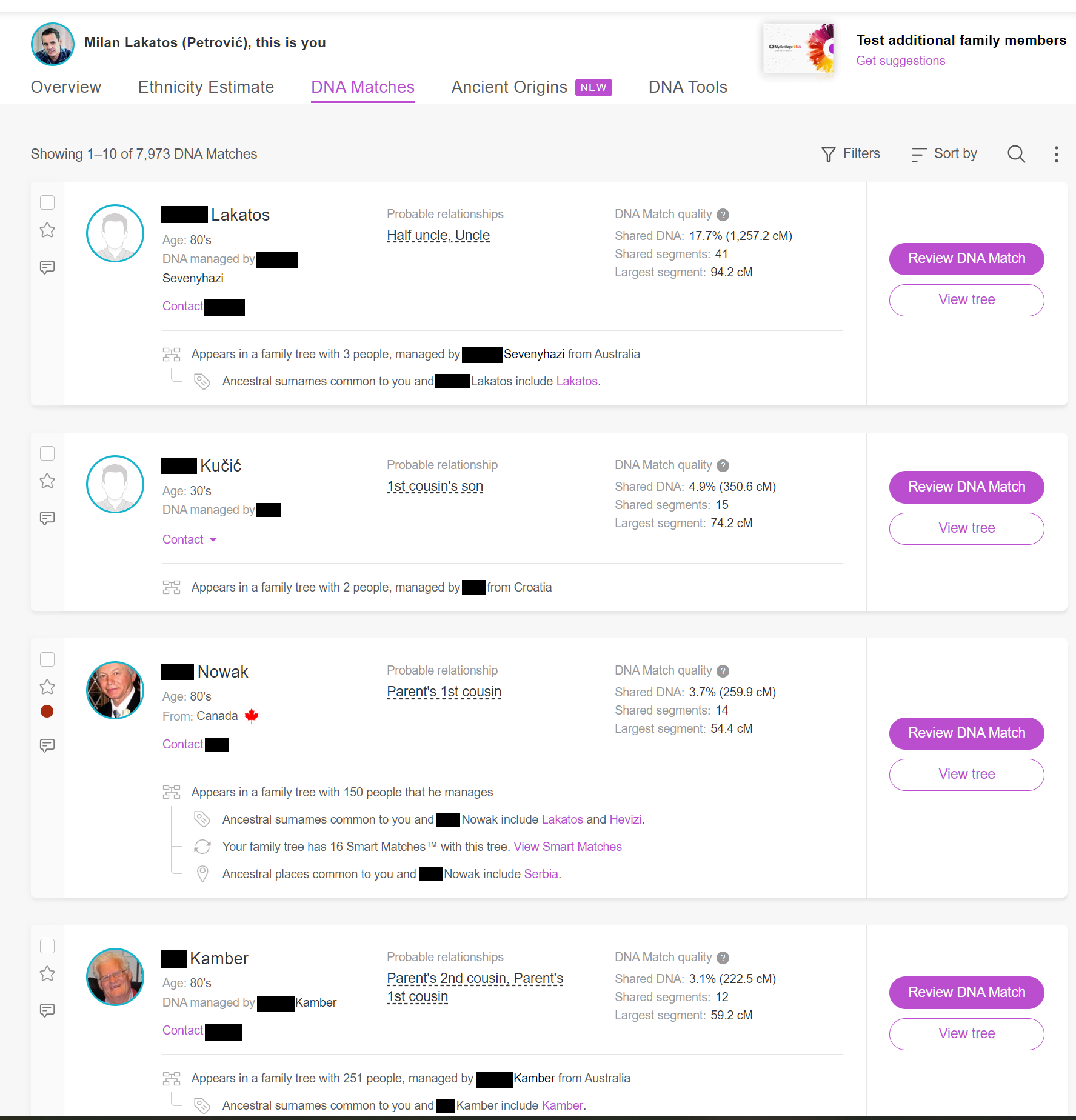
[Embedded figure: DNA-matching account screenshot. The following table is an editorial transcription of its visible matching data; the author’s own description follows below.]
The screenshot is headed “Milan Lakatos (Petrović), this is you” and “DNA Matches”, and shows “1–10 of 7,973 DNA Matches”.
| Profile (first name redacted) | Displayed probable relationship(s) | Shared DNA | Shared segments | Largest segment |
|---|---|---|---|---|
| [redacted] Lakatos | Half uncle; uncle | 17.7% (1,257.2 cM) | 41 | 94.2 cM |
| [redacted] Kučić | First cousin’s son | 4.9% (350.6 cM) | 15 | 74.2 cM |
| [redacted] Nowak | Parent’s first cousin | 3.7% (259.9 cM) | 14 | 54.4 cM |
| [redacted] Kamber | Parent’s second cousin; parent’s first cousin | 3.1% (222.5 cM) | 12 | 59.2 cM |
Additional visible profile information: the Lakatos profile gives an age in the 80s and a three-person family tree managed from Australia, with Lakatos as a common ancestral surname. Kučić gives an age in the 30s and a two-person tree managed from Croatia. Nowak gives an age in the 80s, Canada, a 150-person tree that he manages, the common ancestral surnames Lakatos and Hevizi, 16 Smart Matches between the trees and Serbia as a common ancestral place. Kamber gives an age in the 80s and a 251-person tree managed from Australia, with Kamber as a common ancestral surname. Account managers’ first names are redacted in the public source.
Description of the Image (DNA Analysis — Family Relationships)
“This image shows DNA matches between me, Milivoj Miletić, and my biological relatives, clearly confirming my genetic origin. The image lists:
- [redacted] Lakatos — my paternal uncle (my father’s brother), with whom I share 17.7% DNA, consistent with the expected genetic match for this family relationship.
- [redacted] Kučić — the son of my maternal uncle’s daughter (my maternal uncle is my mother’s brother), with whom I share 4.9% DNA.
Source page 5 — Full translation
- [redacted] Nowak — the son of my paternal grandfather’s sister, with whom I share 3.7% DNA.
- [redacted] Kamber — a relative from the family of my maternal grandmother, with whom I share 3.1% DNA.
This DNA analysis provides scientific and irrefutable evidence that my biological origin is not Serbian, but Croatian-Hungarian, further confirming that my administrative adoption was unlawful and part of a process of forced assimilation. The image clearly shows the genetic connection with my true family, thereby demolishing every attempt to dispute my ethnic identity.”
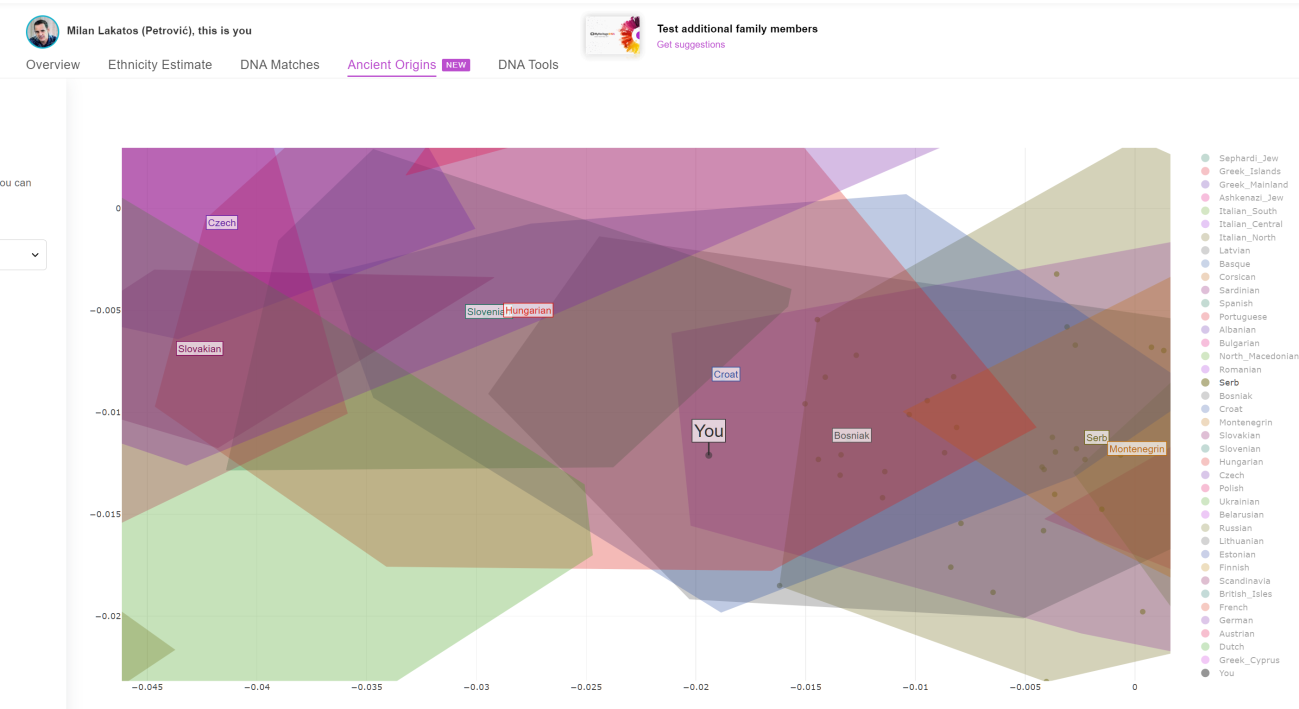
[Embedded figure: an “Ancient Origins” account graphic with coloured population areas and the point labelled “You”. Visible plot labels include Czech, Slovakian, Slovenian, Hungarian, Croat, Bosniak, Serb and Montenegrin. This is the embedded graphic; the interpretation below is the author’s text.]
Description of the Image (DNA Analysis — Ethnic Origin)
This image shows the “Ancient Origins” analysis from MyHeritage, visually representing my genetic origin and connection with ethnic groups in the region.
Key findings from the image:
- My genetic position (marked “You”) clearly overlaps with Croats (Croat), Hungarians (Hungarian), Slovenians (Slovenian) and Bosniaks (Bosniak).
- The Serbian ethnic marker (Serb) is present, but does not encompass my position, meaning that my DNA has no Serbian genetic origin.
- The genetic indicators are wholly consistent with my biological origin — Croatian-Hungarian heritage.
Source page 6 — Full translation
Why Does This Matter?
- If I were ethnically Serbian, my DNA would be within the Serbian genetic cluster, but that is clearly not the case here.
- Genetic analysis proves that the administrative alteration of my identity was unnatural and imposed, without a scientific or biological basis.
- My identity is not a matter of administrative registration, but of genetic reality — which confirms that I am not of Serbian origin.
Conclusion:
This DNA analysis provides scientific and irrefutable evidence that my origin is Croatian-Hungarian, not Serbian, further confirming that my administrative adoption was unlawful and part of a process of forced assimilation. The image clearly shows the genetic connection with my true family, while demolishing every attempt at administratively erasing my identity.
Conclusion
On the basis of the genetic analyses, historical information and legal-administrative facts available to date, it has been clearly established that Milivoj Miletić’s identity is not Serbian, but belongs to his true origin — Croatian-Hungarian. This evidence confirms that Milivoj Miletić’s illegal adoption was carried out through violent administrative manipulation, whereby his true identity was systematically falsified.
My objective is to secure in law my right to my true identity, confirmed through my ancestors’ civil registers, DNA analyses and historical information. Every attempt to dispute my ethnic origin and identity is unacceptable and is fundamentally contrary to the basic laws guaranteeing human rights.
Further steps in these proceedings include initiating court proceedings to restore my identity and approaching international human-rights institutions if the settlement is not accepted. I also intend to expose publicly all aspects of the systemic abuse and administrative violence that caused this situation, in order to prevent further falsification of identity.
The truth has now been clearly proved — Milivoj Miletić is NOT a Serb, but a descendant of Croats and Hungarians, whose identity was forcibly changed through administrative manipulation. My request is simple: I want to be recognized as who I am, with all the rights arising from my true origin.
Editorial provenance note
The six-page source is the author’s undated analysis, incorporating a DNA-matching screenshot and an “Ancient Origins” graphic. It is not an original STR laboratory report and contains no STR marker table. The email of 3 March 2025 names an attachment with the same report title. Acknowledgment of receipt of that message does not establish that the attachment was opened. The analysis itself supplies no composition or submission date.
Later author’s clarification — known family relationships and personal contact
The author explains that the same DNA profile shows matches with the known paternal Lakatos branch and the maternal Kučić and Kamber branches, rather than merely with a person bearing the surname Lakatos. His mother’s mother’s maiden surname was Kamber. The Kučić relative shown is the son of the author’s maternal uncle’s daughter: a man surnamed Kučić married that daughter, and the displayed match is their son. Here, maternal uncle means the author’s mother’s brother, not his father’s brother. The author states that he has also met some of the relatives shown in person, without specifying here which of them he met. This is his later explanation of the family relationships; the report’s original wording and the platform’s displayed probable-relationship labels remain separate.
Comments on source passages (6)
Author’s position — illegal adoption, identity falsification and forced assimilation
The author opens by refusing the falsification of his identity. He calls the adoption unlawful and describes the changes to his name, origin and national identity as administrative violence with lasting legal and personal consequences. His report links this to forced assimilation into a Serbian identity and erasure of his Croatian-Hungarian family and cultural heritage. These are his explicit qualifications, preserved in full.
PDF p. 1
Open related document
Cvita Miletić and Pavle/Pal Lakatoš — family, acknowledgment and probate
The author identifies Cvita Miletić as his Croatian mother from Dalmatia and Pavle/Pal Lakatoš as his Hungarian father. He states that his father cared for him until his death and acknowledged him as his son, and places the subsequent attack on his identity after the probate disclosure of a five-year-old heir. His argument includes inheritance rights, family belonging and the Hungarian language he spoke. The linked claim develops the adoption and family history in the existing court case.
PDF p. 1
Open related document
Paternal I-S17250 and maternal HV6a in the author’s argument
The author uses two lines of descent: I-S17250/I2a1a2 on the paternal side and HV6a on the maternal side. He interprets the former as Central European, with the Lakatoš family probably later assimilated into Hungarian culture, and the latter as Mediterranean/Dalmatian. He uses those interpretations to reject the imposed Serbian identity and support his Croatian-Hungarian heritage. The complete text preserves the populations and geographical areas he names.
PDF p. 2
Open related document
Five autosomal percentages and the author’s ethnic conclusion
The report gives 52.4% Balkan, 31.4% Eastern European, 9.4% Greek-Albanian, 4.1% Baltic and 2.7% Germanic origin. The Balkan heading itself lists Croatia, Bosnia and Herzegovina and Serbia. The author interprets the combination as predominantly Dalmatian/Pannonian and Central European, and concludes that his origin is Croatian-Hungarian rather than Serbian. The percentages and his conclusion remain distinct parts of his full argument.
PDF p. 3
Open related document
Four known family relationships — paternal and maternal branches
The author identifies Lakatos as his father’s brother (17.7% shared DNA); Kučić as the son of his maternal uncle’s daughter, where that uncle is his mother’s brother (4.9%); Nowak as the son of his paternal grandfather’s sister (3.7%); and Kamber as a relative from his maternal grandmother’s family (3.1%). These are his stated family relationships. The screenshot separately shows probable-relationship labels and cM/segment values. In his later clarification he gives Kamber as his maternal grandmother’s maiden surname, explains the Kučić marriage and son, and says he has met some relatives personally. His explanation ties the same profile to known paternal and maternal families, rather than merely to a matching surname.
PDF pp. 4–5
Open related document
Identity restoration and international steps if settlement is rejected
The author’s closing demand is to be recognized as who he is, with all the rights arising from his true origin. He sets out court proceedings to restore identity and approaches to international human-rights institutions if the settlement is not accepted, alongside public exposure of systemic abuse and administrative violence. The linked 3 March 2025 email names a report with this title among the settlement materials; this undated supplied version is preserved as an author’s analysis.
PDF p. 6
Open related document